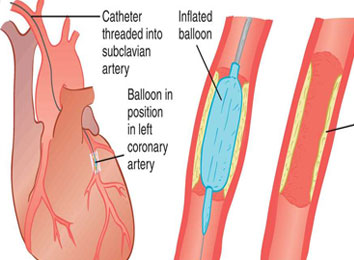
Coronary Angioplasty also known as percutaneous coronary intervention involves a small incision to be made in the arm or groin to find an artery. The cardiologist leads a thin wire through the incision to the blocked artery. As soon as the wire reaches the blocked artery, a catheter with a deflated balloon is passed over the inserted wire to the blocked area. When the tube reaches the blockage the balloon is inflated which in turn widens the artery the increase the blood flow. Plaque removers may be used to remove the deposited plaque from the walls of the artery. Modern devices like stents are used to keep the artery open. A stent is permanently fixed. After about 4 to 5 hours of the Coronary Angioplasty the wire and catheter are removed.
Angioplasty is derived from the words ‘Angio’ meaning vessel and plasticos which means fit for molding. Angioplasty is a medical procedure which involves the alteration of a narrowed or obstructed vascular lumen usually caused by atheroma. All kinds of vascular interventions performed in minimally invasive or percutaneous method are a part of the angioplasty. Angioplasty was first used in 1977 where a tiny balloon was used to open and widen narrowed arteries. Now the procedure has improved with the use of modern devices like stents, laser and new methods.
How long does the Coronary Angioplasty procedure take ?
Percutaneous coronary intervention usually takes about 2 hours. During the procedure, the patient is kept awake but feels drowsy due to the effect of medication given to him.
Coronary Angioplasty Facilities
The Cardiologists at Hospitals have pioneered Coronary Artery Stenting in India. They have specialized in techniques including Percutaneous Transluminal Septal Myocardial Ablation.
There has been a latest advancement in Coronary Angiopalsty in the form of Fractional Flow Reserve (FFR), which is available in India too.
Benefits of Coronary Angioplasty
The main aim of Coronary Angioplasty is to widen the narrowed blood vessels, in order to increase the flow of blood to the heart. Another prime benefit is that it also decreases the risk of a heart attack, reduces the symptoms of angina, and also considerably slows down the progress of coronary artery diseases.
What to expect after Coronary Angioplasty ?
- The procedure of Cornoary Angioplasty improves the flow of blood through the coronary arteries. It might also eradicate the need of coronary artery bypass surgery too.
- After surgery one gets relief from chest pain improving capacity of exercising. In some cases, there is complete elimination of the narrowing and even blockage.
- Although the procedure treats the condition, but does not completely cure. Regular narrowing over a span of 6 months can occur in some of the cases, which might not always need a complete repeat procedure.
- A patients should eat right, exercise, give up smoking, and reduce taking stress so that the chances of reappearance are lowered down. The specialist might prescribe a medication, may be a statin drug, for lowering down the cholesterol of the patient.
- It is possible that in case the arteries do not get sufficiently widened or the blockages are quite severe to get treated by coronary angioplasty, then heart surgery (CABG surgery) might be recommended.
Angioplasty vs. Bypass Surgery
It is not easy for a patient to make a choice between angioplasty and bypass surgery on his own, which happens due to various factors like the condition of the disease in an individual. The doctor also checks the symptoms of the patient along with his overall heart function and co-existing medical conditions.
In case the narrowing in the arteries is serious about reducing the blood flow in the heart of the patient then angioplasty is recommended. But if the patient has various blockages, bypass surgery is certainly better.
FAQs for Coronary Angioplasty
What is the role of angioplasty and stenting?
Angioplasty is a non-surgical procedure devised to unclog the blocked arteries. This procedure is carried out in a cardiac catheterization laboratory. Stenting is a device used to open the clogged arteries to restore blood flow.
What is the difference between angioplasty and stenting?
Angioplasty is a non-surgical procedure used to unclog blocked and narrow blood vessels that supply the blood to our hearts. The blood vessels are known as coronary arteries.
Stenting is a small, metal mesh tube that expands inside the coronary artery. The stent is placed straight away or during angioplasty. It is a drug-eluting that has medicines rooted in it and helps to restore the flow of blood in the arteries.
How angiography and angioplasty differ from each other?
Angiography is a medical examination performed to detect blocked zones in the coronary artery with a specific CT scanner and iodine. However, angioplasty is a medical procedure where blocked arteries are broadened up to restore blood flow with the help of a stent.
Is angioplasty performed only for the heart?
Angioplasty can be conducted for expanding blockage in various blood vessels of our body. If angioplasty has been performed for coronary blood vessels then it is called Coronary Angioplasty otherwise for unblocking other body blood vessels it is called Carotid Artery.
Why is Angioplasty performed?
The main reason for performing angioplasty is to broaden tightened arteries. If our arteries are blocked or not broadened enough then there will not be sufficient flow of blood in our heart which can cause a lack of oxygen. This procedure also reduces the risk of a heart attack in those patients who have severe narrow or blocked arteries.
What does a patient ask to do after the angioplasty?
A patient is asked to drink lots of water to help flush away the iodine contrast dye from the body system. On the site of insertion, a sandbag or pressure bandage is placed to prevent the bleeding. You’ll be asked to take a rest for the next few hours.
Where Angioplasty performed in the hospital and how long does it take to perform?
Angioplasty was performed in the Cardiac Catheterization lab of the Cardiology Department in the hospital. This lab room is well-equipped with all specialized facilities and has advanced imaging technologies. This procedure takes 1 to 2 hours to finish, but the patient needs at least 12 to 16 hours for recovery.
What are the different types of Angioplasty?
- Balloon Angioplasty- In this procedure, a specifically designed catheter with a tiny balloon uses. The catheter is wisely directed through the artery to the blockage, then it inflates to open and increase blood flow to the heart.
- Laser Angioplasty- It is an advanced technique that can be used to open coronary arteries blocked by plaque. A catheter with a laser in its tip has been inserted into an artery.
- Atherectomy- It is a minimally invasive endovascular surgery technique for removing atherosclerosis from blood vessels within the body. This procedure is specifically used to treat very hard blockages.
- Stenting- It is a tiny tube inserted into a blocked passageway to have it open. The stent reinstates blood flow and other fluids depending on where it is placed.
In which case stents are used?
The stent can be used with angioplasty or after that. It depends on the type of artery blockages such as where exactly is the blockage, the size of blockage and the size of the arteries. Nowadays it is a common procedure and 70 to 80% of patients need this procedure.
How can I prepare for angioplasty?
There are some important preparations to perform angioplasty that should be followed step by step.
Firstly, the doctor performs a test called Coronary Angiography before angioplasty to check the blockage in arteries. The patient is instructed to remain with an empty stomach for at least 8 hours before angioplasty. The necessary change in diet and lifestyle is very important.
How is Coronary Angioplasty performed?
The patient has to admit and will be given some fluids, medication and blood-thinning substances through an IV catheter. The doctor regularly monitors blood pressure, heart rate, and the amount of oxygen in the body. Local anesthesia will be given through a small incision so that you do not feel pain during the procedure. The cardiologist makes a small incision in the artery and inserts a hollow catheter and directs it towards the occluded coronary artery. The number of blockages will be decided which type of angioplasty will be performed.
Can the stent slip from its position where it was implanted?
No, there is no chance of slipping the stent from its place as it is implanted in the artery properly with a balloon at high pressures. After a few weeks of angioplasty, the stent gets roofed by the lining and becomes a part of the artery.
Does stent become rusty in the body as it is made of steel?
Stent material is a special type of medical-grade steel, which is rustproof and made of Cobalt, Chromium, and Platinum.
Can I undergo an x-ray, CT scan or MRI after Stenting?
X-Ray and CT scans can be done any time after the Coronary Angioplasty. However, for MRI you should wait until one month after the procedure.
Can I live a normal life after angioplasty?
Yes, you can live a normal life and the success rate of this procedure is very good.
You can go back to your normal routine after angioplasty without any hassle. Many patients can go back to their early lifestyle after 3 days but consult with your doctor before starting anything new. Most importantly, you should change your diet and lifestyle. Exercise will be recommended by the doctor to maintain a healthy lifestyle.
Does an aspirin helps in preventing heart attack?
Yes, taking Aspirin daily reduces the chances of strokes and heart attacks. However, it is a blood thinner medicine. So, you should always consult your doctor about the dose and duration of this medicine.
Can I smoke and consume alcohol after angioplasty?
You should QUIT both because both are risky for your health. You can have moderate drinking but excess is harmful. Smoking makes blood vessels tighten which can cause a heart attack.
What should I eat after angioplasty?
Diet plays a very important role in reducing the risk of heart attack and artery blockage. Avoid fried food and fatty food. Always select a high fiber diet and whole grain. Eating vegetables and fruits is beneficial for health.
What is the approximate cost for Coronary Angioplasty? How can I get an appointment?
Coronary Angioplasty's approximate cost is around USD 2200. For an appointment or any other detail, kindly contact on below details:
Email: [email protected]
Mobile/Whatsapp: +91 9717766080